
Enterprise organisations have spent years transforming where people work. Far fewer have transformed how leadership communicates.
That’s starting to change.
Across EMEA, organisations are beginning to operate more like media companies, producing a constant flow of live and on-demand content for employees, partners and stakeholders across multiple regions, platforms and devices.
Executive town halls, leadership updates, hybrid events and internal broadcasts are now expected to deliver the same clarity and reliability people experience every day through streaming platforms and live media environments.
As a result, enterprise communication is entering a new era.
The lines between broadcast, enterprise AV and collaboration technology are rapidly disappearing. In their place, organisations are building more connected communication environments designed around scalability, resilience and experience quality.
Why Communication Expectations have Changed
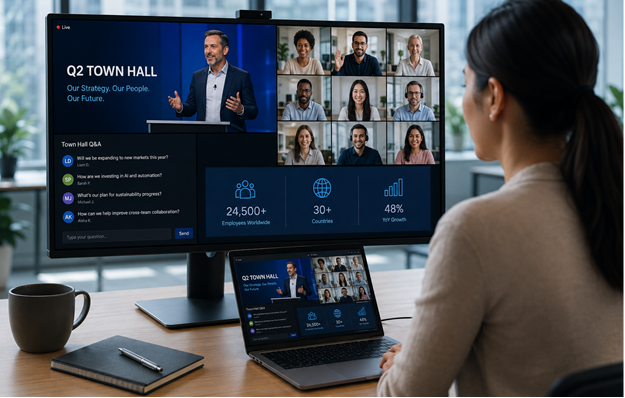
Hybrid work fundamentally changed how organisations communicate.
Employees now expect communication experiences that feel seamless, accessible and consistent regardless of location. Poor audio, unreliable streaming or fragmented collaboration experiences create friction quickly, especially when leadership visibility increasingly happens through digital channels.
Communication quality now directly shapes how organisations build culture, maintain alignment and engage distributed teams.
This shift is pushing organisations to rethink infrastructure as a strategic business function rather than a supporting technology layer.
At the same time, enterprise requirements are becoming more complex. Many organisations are now balancing:
- Multilingual communication across regions
- Hybrid and remote workforces
- Scalable enterprise content delivery
- Increased executive visibility
- Accessibility expectations
- Sustainability and reduced travel initiatives
- Higher reliability
- Repeatable workflows
- Scalable communication
- Centralised management
- Better audience engagement
- More consistent experiences across regions
- Multilingual communication delivery
- Automated content tagging and management
- Intelligent meeting and event summaries
- Accessibility optimisation
- Content personalisation
- Workflow automation across enterprise streaming platforms
The result is a growing demand for communication environments that are scalable, reliable and easier to manage across multiple locations.
Enterprises are Adopting Broadcast Thinking
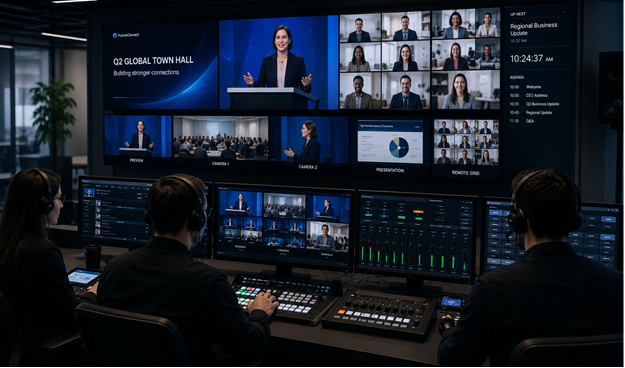
Broadcast environments were built around consistency, resilience and audience experience. Those same principles are now shaping enterprise communication strategy.
Organisations are increasingly adopting broadcast workflows, enterprise streaming platforms and live production technologies because they support:
This does not mean every organisation is building television studios inside the workplace.
It means enterprise communication is becoming more strategic, more interactive and more experience-driven.
The most effective communication environments are often the ones people barely notice. When audio feels natural, visuals are seamless and workflows simply work, the focus stays on the message rather than the technology behind it.
In many ways, enterprise AV has become the invisible storyteller of modern organisations.
AI and the Future of Enterprise Communication
Artificial intelligence is also starting to reshape enterprise communication strategies, particularly across multilingual EMEA environments.
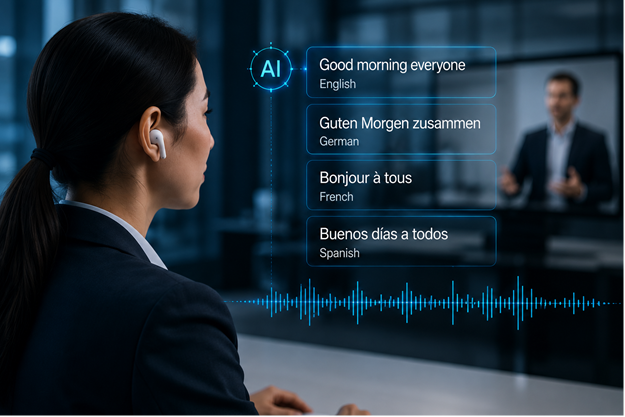
AI-driven captioning, automated localisation, real-time translation and intelligent content management are helping organisations improve accessibility and streamline content delivery at scale.
At the same time, AI-assisted production workflows are reducing operational complexity and making it easier to manage increasing communication demands efficiently.
As enterprise communication infrastructure continues to evolve, AI is expected to play a bigger role in:
For global organisations operating across multiple regions and languages, these capabilities are becoming increasingly valuable in creating more consistent, scalable and accessible communication experiences.
What Happens Next
Over the next few years, we predict that the distinction between broadcast, AV and workplace collaboration will continue to narrow.
AI and automation will continue to improve how organisations scale communication, accessibility and engagement across regions and teams.
At the same time, organisations are recognising that communication infrastructure increasingly impacts employee engagement, leadership visibility and organisational alignment.
Broadcast-quality communication is no longer just about production value. It is becoming a business expectation.
Communication is no longer just a support function. It’s becoming operational infrastructure.
The organisations that adapt early will be the ones best positioned to communicate clearly, engage consistently and scale effectively in an increasingly digital-first world.
